
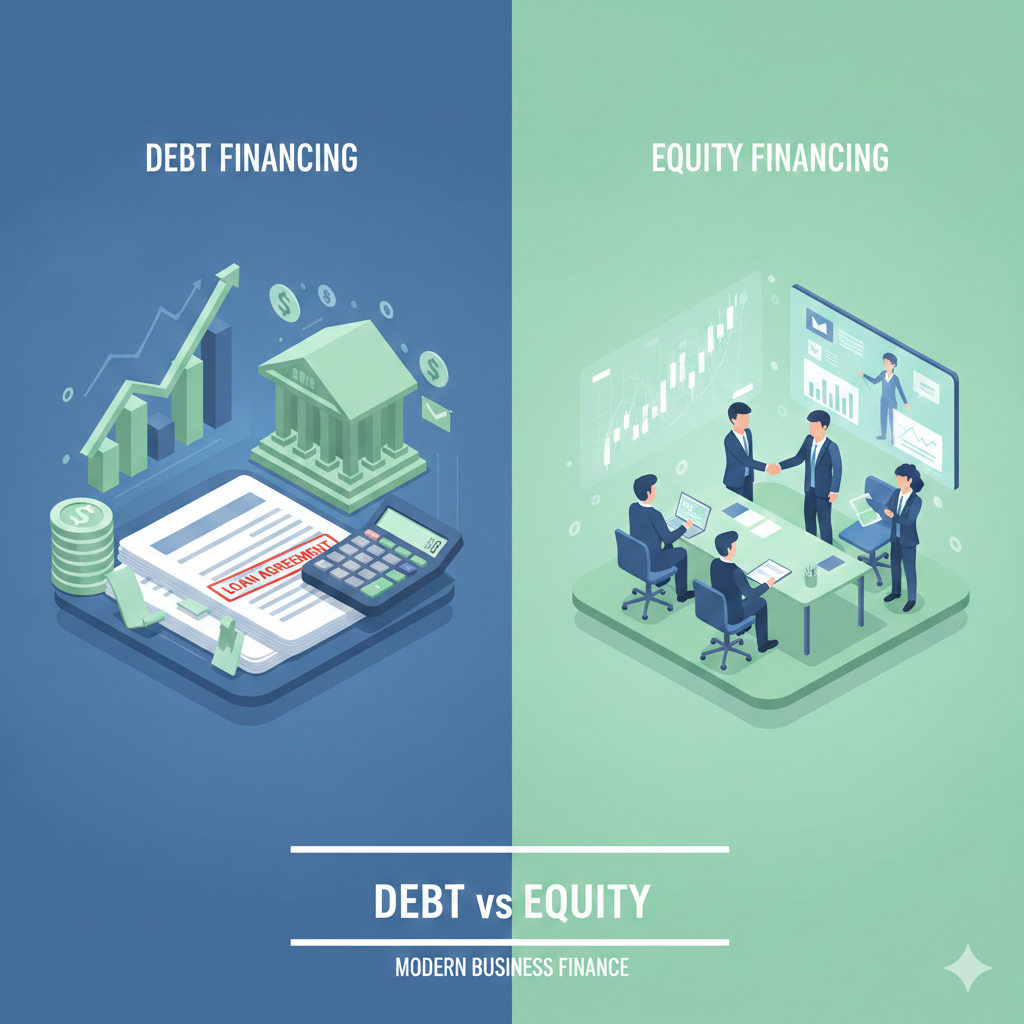
Before getting into the details, understand the core idea. Every business needs money to operate, grow, hire, build products, and compete. The way a company raises that money is called its capital structure.
The central question is simple but critical: should a company borrow money or sell ownership?
This decision affects risk, profitability, valuation, investor confidence, and long-term survival. Investors analyze capital structure constantly, and management adjusts it as the company evolves.
In this guide, you will understand debt vs equity financing, advantages, risks, formulas, ratios, real examples, and how companies choose the right balance.
What Capital Structure Means
Capital structure is the mix of funding sources used by a company.
Main components:
-
Debt
-
Equity
-
Retained earnings
Why it matters:
-
Determines financial risk
-
Impacts cost of capital
-
Influences valuation
-
Affects growth speed
-
Signals stability to investors
Too much debt increases bankruptcy risk. Too much equity reduces ownership and returns. The goal is balance.
Debt Financing Explained
Debt financing means borrowing money that must be repaid with interest.
Common sources:
-
Bank loans
-
Corporate bonds
-
Credit lines
-
Asset financing
-
Leasing
Key characteristics:
-
Fixed repayment schedule
-
Interest expense
-
No ownership dilution
-
Increases leverage
Advantages:
-
Founders keep control
-
Interest is tax deductible
-
Often cheaper than equity
-
Boosts returns when growth is strong
Disadvantages:
-
Cash flow pressure
-
Default risk
-
Credit rating impact
-
Less flexibility during downturns
Debt works best when revenue is predictable.
Equity Financing Explained
Equity financing means raising money by selling shares of the company.
Sources:
-
Venture capital
-
Angel investors
-
Private equity
-
Public markets (IPO)
Key characteristics:
-
No required repayment
-
Investors share profits
-
Ownership dilution
-
Long-term partnership
Advantages:
-
Lower financial risk
-
Greater flexibility
-
Strategic support
-
Suitable for early-stage companies
Disadvantages:
-
Loss of control
-
Profit sharing
-
Slower decision making
-
Higher long-term cost
Equity buys time but costs ownership.
Debt vs Equity Financing — Key Differences
Ownership:
-
Debt: no ownership transfer
-
Equity: ownership dilution
Risk:
-
Debt increases financial risk
-
Equity spreads risk
Cost:
-
Debt = interest payments
-
Equity = shared future profits
Cash flow:
-
Debt requires fixed payments
-
Equity is flexible
Return potential:
-
Debt amplifies returns
-
Equity stabilizes growth
The trade-off defines capital strategy.
Why Capital Structure Matters
Capital structure influences:
-
Profit margins
-
Company valuation
-
Expansion ability
-
Investor trust
-
Resilience during crises
A poor funding mix can destroy value even if the business is strong.
Cost of Capital and WACC
The weighted average cost of capital (WACC) measures how expensive financing is overall.
Key ideas:
-
Debt is usually cheaper
-
Too much debt increases risk
-
Investors demand higher returns when risk rises
Lower WACC generally means higher company value.
Companies continuously adjust their mix to optimize WACC.
When Companies Prefer Debt
Debt is preferred when:
-
Cash flow is stable
-
Interest rates are low
-
Management wants control
-
Expansion opportunities exist
-
Assets can be used as collateral
Industries using more debt:
-
Real estate
-
Utilities
-
Manufacturing
-
Telecommunications
Predictability supports borrowing.
When Companies Prefer Equity
Equity is preferred when:
-
Revenue is uncertain
-
Growth is aggressive
-
Risk is high
-
The company is early stage
-
Innovation requires flexibility
Industries using more equity:
-
Technology
-
SaaS
-
Biotech
-
Startups
Equity absorbs uncertainty.
Optimal Capital Structure
There is no universal formula.
The optimal mix:
-
Minimizes cost
-
Supports growth
-
Controls risk
-
Matches industry standards
Factors affecting the decision:
-
Business model
-
Market conditions
-
Interest rates
-
Growth stage
-
Management strategy
The optimal structure changes over time.
Important Ratios Investors Use
Debt-to-equity ratio measures leverage.
Interest coverage ratio measures ability to pay interest.
Debt ratio shows how much assets rely on borrowing.
Equity ratio reflects financial stability.
Free cash flow analysis shows repayment capacity.
Investors compare these ratios across competitors.
Capital Structure Strategies
Conservative strategy:
-
Low debt
-
High stability
-
Slower growth
Aggressive strategy:
-
High leverage
-
Higher returns
-
Greater risk
Balanced strategy:
-
Moderate leverage
-
Sustainable expansion
-
Strong investor appeal
Most successful companies operate between conservative and aggressive.
Interest Rates and Economic Cycles
When rates are low:
-
Borrowing increases
-
Leverage rises
-
Expansion accelerates
When rates are high:
-
Equity becomes attractive
-
Companies reduce debt
-
Valuations shift
Macroeconomics directly shapes capital structure decisions.
Startups vs Mature Companies
Startups rely heavily on equity because cash flow is uncertain.
Growth-stage firms mix debt and equity.
Mature companies use more debt due to stable revenue.
Lifecycle stage determines financing strategy.
Risks of Poor Capital Structure
Excessive debt risks:
-
Liquidity crises
-
Forced asset sales
-
Bankruptcy
Excessive equity risks:
-
Founder dilution
-
Lower return on equity
-
Investor pressure
Other risks:
-
Market shocks
-
Refinancing risk
-
Valuation decline
Misalignment between risk and funding is a common failure factor.
How Managers Decide the Mix
Typical process:
-
Forecast revenue and cash flow
-
Calculate financing costs
-
Stress-test scenarios
-
Evaluate market conditions
-
Compare competitors
-
Align with strategy
Capital structure is a strategic decision, not just a financial one.
Major Capital Structure Theories
Modigliani-Miller theory suggests structure doesn’t matter in perfect markets.
Trade-off theory balances tax benefits of debt with bankruptcy risk.
Pecking order theory says firms prefer internal funds, then debt, then equity.
These frameworks guide financial planning.
Quick Answer
Debt financing means borrowing with fixed repayment and higher financial risk.
Equity financing means selling ownership with lower financial pressure.
The best capital structure combines both to reduce cost and support growth.
Practical Example
A company needs $10 million.
More debt:
-
Higher returns
-
Higher risk
-
Ownership preserved
More equity:
-
Lower pressure
-
Ownership diluted
-
Flexible growth
The right choice depends on stability, market timing, and growth goals.
Trends Shaping Capital Structure
-
Hybrid financing instruments
-
Private markets growth
-
AI-driven financial modeling
-
Revenue-based financing
-
Alternative credit platforms
Flexibility is becoming more important than rigid structures.
Conclusion
Capital structure explained through debt vs equity financing is ultimately about balance. The mix determines risk, growth potential, valuation, and investor confidence.
Stable businesses lean toward debt because they can manage repayments. High-growth companies lean toward equity because they need flexibility. Most successful companies combine both and adjust continuously.
Understanding capital structure gives investors deeper insight, helps founders make smarter funding decisions, and allows managers to scale without losing financial stability.
The debate between debt and equity never ends because the right answer depends on timing, industry, risk tolerance, and strategy. The companies that master this balance build stronger foundations, scale faster, and survive economic cycles with confidence.